Sunday, October 12, 2008

Recent happenings

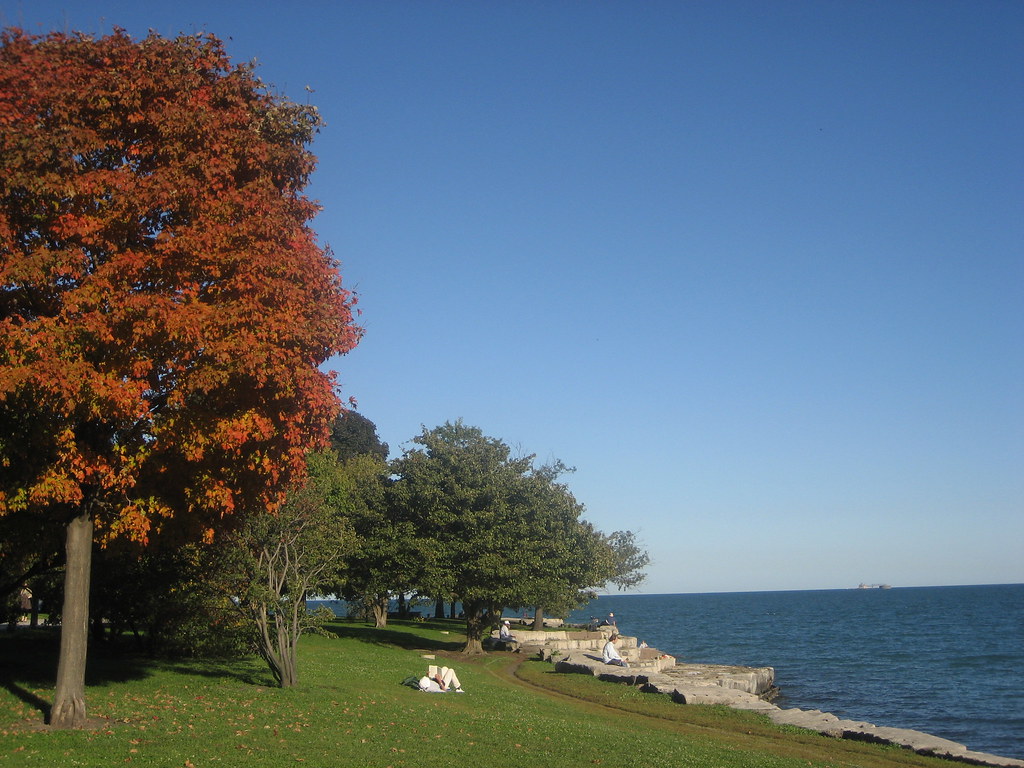
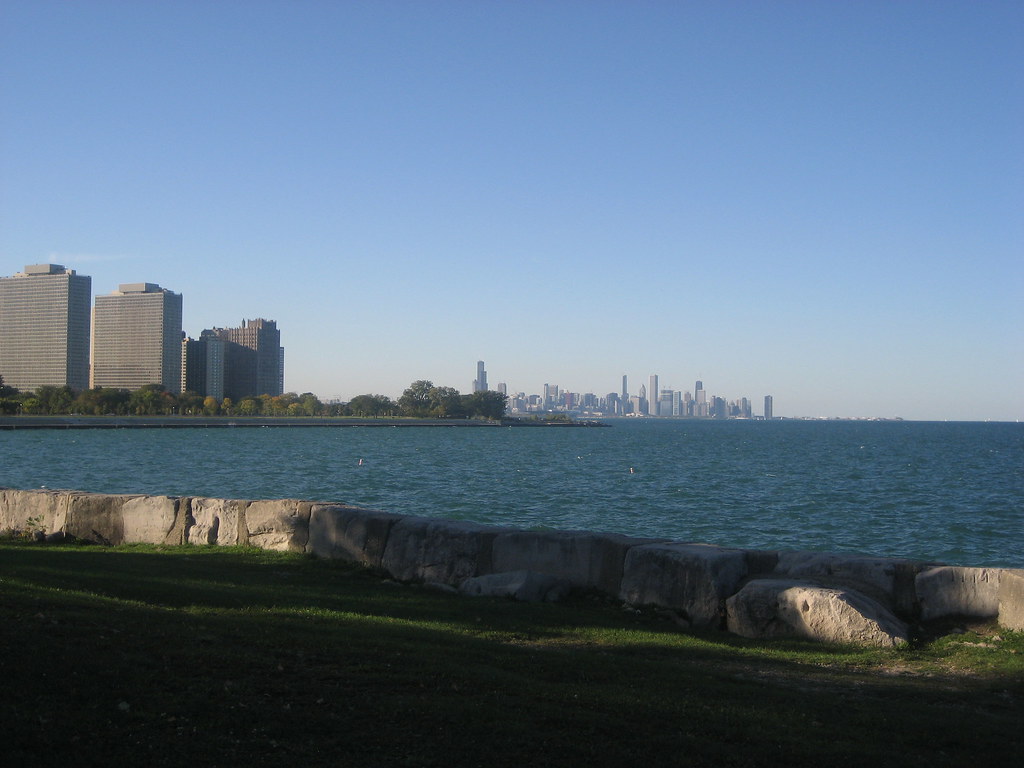
The weather was beautiful this weekend. I enjoyed it first by riding my bike along Lake Michigan and spending some time at The Point on Friday.


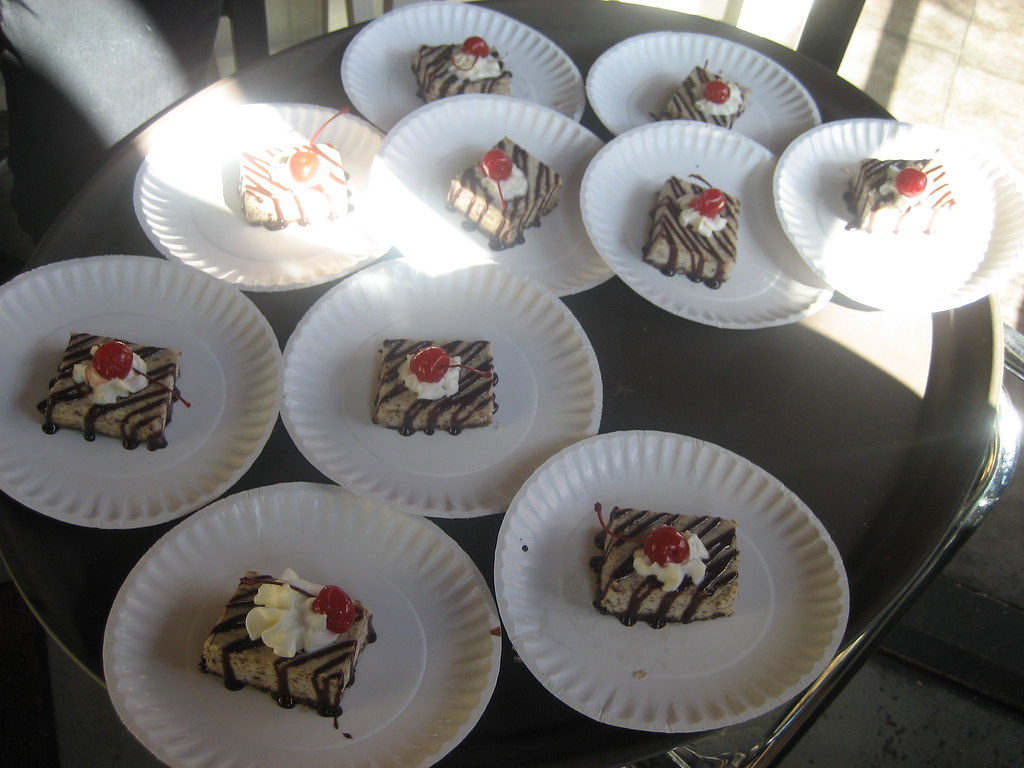
Saturday there was a BBQ, and this afternoon, I attended the Andersonville 2nd Annual Dessert crawl. Three hours, 12 bite-sized desserts. There were two routes to pick from, one from 1-4pm and another from 3-6pm, with largely different selections of restaurant. Two of the locations were actually stores selling treats from restaurants not directly located on the route, and one shop was just giving away coupons (15% off a full-sized cake, thanks a lot) instead of actual edibles. Otherwise, the desserts were mostly good, if a little standard. Below are some of the more interesting selections:


For descriptions and more photos, visit my Flickr set. In the end, I felt it was a little expensive ($25) for what we got, and I expected something more stand-out from a lot of places (Ann Sather had brownies, for example, when they're known for being a Swedish restaurant).

Still, we finished off the afternoon with some beers at Hopleaf; I tried the Flemish Sour Red Ale, by Monk's Cafe, which lived up to its name (I would get it again; I found the tartness refreshing, especially after an afternoon of sweets).

Made pizza for dinner just now, with ingredients leftover from massive pizza-making efforts on Thursday: homemade crust and sauce, with mushrooms, mozzarella, and ricotta. Mmm.
The weather is supposed to be nice again tomorrow, but it turns sour Tuesday. No big deal; I leave for Houston Thursday afternoon!

Tuesday, October 7, 2008

Post 300!

And to celebrate, I am voting in my first presidential election!

That's right, Missouri and the Illinois mail system decide NOT to screw me over this year when it comes to voting, and my absentee ballot arrived yesterday. I've got to finish filling that sucker out, mail it in, find a friggin' notary, and my vote is cast.

Speaking of reaching goals, I had a thought yesterday as my bus to work drove past a campus sidewalk closed due to construction. See, there is never not some kind of construction work going on on my campus. Right now a new dorm is being built, as well as an addition to the main library, they're cleaning or reinforcing the outside of Rockefeller Chapel and Stuart Hall...and when those are finished, they'll move on to other ones. We have a gorgeous campus at the University of Chicago, but the view is always partly blighter by scaffolding. Which prompts me to wonder:

Is the construction construction taking place on my campus a metaphor for the fact that our education is never complete? (And that we must keep pouring money into it?)

Sunday, October 5, 2008

An ethical quandary, and an indulgent day of cooking

The ethical quandary has to do yesterday's conviction of O.J. Simpson for armed robbery and kidnapping. Yes, I do mean the same O.J. Simpson who was exonerated 13 years ago for murder.

Now, I only know the vague details of this current case (the article is not especially well-written), and I'm also only vaguely familiar with the details of the 1995 case, as I was all of eight-years-old at the time. I do not have an opinion on whether or not Simpson was guilty in either case. Disregarding the facts (which may seem like a dangerous thing to do) in either case, however, I was stunned to read this:

...prosecutors told jurors during opening statements that the armed confrontation at the Palace Station hotel and casino grew out of grudges Simpson had nursed since his murder trial and civil case, and suggested that they could right a wrong by convicting him.

"You will be able to write that final chapter, the chapter of arrogance and hypocrisy and that will be the true verdict. The verdict you can feel good about," prosecutor Christopher Owens said at the time.

First assuming the prosecutor actually meant to say, "write the final chapter on this story of arrogance and hypocrisy" rather than what he literally said, what is said here strikes me as incredibly unethical. The prosecutor is asking the jury to convict Simpson for crimes he was aquitted of over a decade ago, because in the prosecutor's belief Simpson should not have been aquitted of those crimes. To me, this seems to undermine the point of our legal system. Even if Simpson is guilty of those murders, in which case a guilty verdict could in fact be seen as righting a wrong, it would not be a "true verdict" in the matter of the case at hand. It is distinctly NOT the role of this jury to determine Simpson's innocence or guilt in matters the court has already dealt with, and I think the prosecutor is crossing an ethical boundary by giving them that responsibility.

As I said, I don't have an opinion about Simpson's guilt. I think it's likely that he is in fact guilty of the crimes he was convicted of yesterday, and there may be character evidence, related to the murders/murder trial, that came into play in the robbery incident, but the result of his previous trial is neither here nor there.

Anyway, I don't have anything else to add on this matter. But I was really bothered by the prosecutor's plea to the jury to right a wrong of the past--because it goes against my understanding of the law.

On a less serious note, today was a day for indulgent food. First, I made chocolate cake--in a mug, in the microwave.

The main downside to this cake--because what could be wrong with a cake that takes five minutes to make?--is that it is very dense, without having enough flavor to make that density appreciable. I'd like to find a way to either have the cake turn out fluffier, or have a stronger flavor. But you should definitely try it if you're craving cake.

Second, while I was at the grocery store buying cocoa for the mug-cake experiment, I noticed that avocados were only $1 and purchased three which ended going into what is possibly the most delicious guacamole I have ever made.

It's all gone now, but it was excellent while it lasted. Three avocados, 1 large clove of garlic (probably equivalent to two regular cloves), a handful of chopped fresh cilantro, the juice of half a lime, dash of salt and pepper, and a small amount of dried chile de arbol. Mmm.

Otherwise, not much going on today. Thanks to a couple of late nights, I ended up sleeping until almost 1pm. I've done a bit of reading, picked up stuff around my room, and purched food for a couple other meals.

Tuesday, September 23, 2008

Getting started on my thesis

My last (!) term of school is approaching, and consequently I've been thinking about getting started on my thesis, which is pretty much all I have lined up for myself to do until June. I've written a few of my ideas here before; presumably I've been pruning and refining them some. Mainly I think I still need to narrow things down, things being defined as "what I am going to talk about," the hope being that once I've got things narrowed down I'll actually be able to figure out what I want to say.

So, here are my current thoughts on the matter of horror fiction and its usefulness to ethical/moral philosophy. (BE WARNED: this is a beast of a post, and I understand if you don't read it.)

In the Modern American Horror Film class I took last Spring, we read Projected Fears: Horror Films and American Culture (Kendall R. Phillips) a book with the thesis that horror films (at least, American horror films from Dracula to Scream) reflect the societal terrors of the era during which they were produced. Phillips and others make the (often convincing) argument that horror films are socially important.

What I want to know is, are horror films (and novels and stories, etc) also morally and philosophically important?

For me, philosophy refers to the individual, as opposed to society. When I look at individuals in stories, however, I must necessarily look at them as standing for multiple existent individuals--otherwise, I would simply be examining the moral life of a specific character of fiction. To be relevant, such examinations must be applicable to real people.

This should not be controversial; after all, Kant's Categorical Imperative implies that for any given situation, there is one moral way to act. The particulars and circumstances surrounding the individual in question cannot come into play.

I am obviously not the first person to question the philosophical validity of horror; Noel Carrol's The Philosophy of Horror does just what its title implies--creates/defines/uncovers a philosophy of the genre. I have only read part of the book so far, but as Carrol outlines his intent very clearly in the introduction, I feel comfortable saying that my purpose is more specific is (also, that we don't agree on everything--or at least, that our different goals necessarily require different approaches). For Carrol, in a (unfairly simplistic) nutshell, horror is about how the protagonist (and the reader/viewer, vicariously) feel simultaneously threatened and revolted by the monster. And a monster needs to be unambiguously threatening AND revolting in order to be a horrifying monster.

Okay, fine. However, I feel that for my question to be meaningful (Is horror morally relevant?), the concept of a monster, what it is that causes the sense of horror, and what role the protagonist plays all need to be more complicated than that. (Another distinct difference--Carrol's approaches focuses largely on the audience of the work of horror, and I don't intend to consider audience very much, if at all).

Right now, two...I'm not exactly sure what to call them, scenarios?...are occupying my mind, when it comes to common scenarios in horror works with potential moral/philosophical relevance: a) how the protagonists react to the situation they end up in and b) protagonist as monster/monsters that remind us of the terrible things about ourselves. I'll take them up separately, as far as I've thought them through so far.

I. The "Survivor Scenario"

To quote "Firefly's" Shepherd Book (who in turn is quoting the Qin Dynasty general Xiang Yu):

Live with a man 40 years—share his house, his meals, speak on every subject. Then tie him up and hold him over the volcano’s edge—and on that day, you will finally meet the man.
While I don't necessarily agree with this concept in my own life, I think it's an interesting rhetorical and literary device, and one that rears its head fairly frequently in the horror genre.

When considering this scenario, the focus is off the monster, and really on what is happening to the people (protagonists, victims, etc) in the situation created by the monster. What does the situation do them? How does it change them? How do their attitudes toward each other change?

John Carpenter's The Thing and George A. Romero's Night of the Living Dead are great examples from cinema. In The Thing, men at an Antarctic base turn don't know who they can trust after their base s invaded by a shapeshifting alien; in Night, survivors of a zombie outbreak become fatally distracted from the threat at hand by their need to be right. As for things I've read recently, Scott Smith's The Ruins and Stephen King's "The Mist" also both address the Survivor Scenario in similar fashion: in the former, six people who find themselves quarantined are manipulated into quarreling and taking sides, and in the latter, the only survivors (as far as they know) of an experiment gone terribly wrong and holed up inside a supermarket, a few individuals find remarkable courage as they struggle against the growing insanity and calls for sacrifice of the others.

Does it always come to pass that the protagonists turn against each other in these situations? If so, the Survivor Scenario seems a lot less complex and consequently, less useful philosophically. If it comes down to the simple principle that "When people end up in dire situations, they turn against each other," there isn't much work to do (likewise, the corollary of "if they don't turn against each other, they bond with each other" also doesn't leave a lot of room for exploration).

I plan to read Richard Matheson's "I am Legend" as a possible answer to this--after all, if the main character is alone, there is no ally to turn against or bond with (unless his dog counts; I haven't read it yet, and neither have I seen the recent movie version).

Whatever the answer ends up being, how the protagonists in a story respond to their situation is one of the things I almost always find most compelling about the horror genre.

II. The "Mr. Hyde Scenario"

If my clevel moniker is not clear enough, "The Outsider" and "Shadow Over Innsmouth" (both by H.P. Lovecraft) both provide examples of the other type of scenario that I see as potentially philosophically rich: protagonist as monster.

This scenario is closer to what Carrol deems philosophically relevant about horror in that some focus must be directed to the specifics of the monster--appearance/form, origin, and, especially compelling for me, the monster's relation to the protagonist/s. This last aspect can take a variety of forms; for example, in the Lovecraft stories I referred to (SPOILER ALERT!) the narrator/protagonist in each case comes to discover that he is the very monster that causes so much loathing (in the first case) or that he himself cannot abide (in the second). Dr. Jekyll and Mr. Hyde is obviously another example of this, as is Frankenstein.

However, I'm also interested in monsters that aren;t so directly tied to the protagonists, but find some other way to cause the protagonists to look upon themselves in horror by recognizing something in the beast that is also in themselves. Though I don't believe Carrol addresses this role the monster can play in quite this way, it touches on some of what he says (and I believe that Julia Kristeva's writings on abjection will aso be useful). Take zombies as an example: they are not only threatening/horrifying because they lust after human flesh--because they used to be human, they remind humanity of our own mortality and the looming presence of death; they remind us of the most vile, shameful aspect of our physicality. Even less directly, the way a monster looks or behaves can act as metaphor for human action and behavior (I can't think of an example for this off-hand).

The way that both of these scenarios come together to help me is in their focus on the effect of the horrifying events on the protagonist.
Monday, September 22, 2008

Are you ready for November 4?

Two things* have been occupying my time a great deal recently, and they are beautifully illustrated together below:

*the election and playing Katamari

I never intended this blog to be about politics (mine or anyone else's), and I want to keep it that way, but I don't think I'll be straying too far from that intention if I take the time to ask a few simple questions:

Are you registered to vote? Have you double-checked?

Furthermore, if you intend to vote absentee/early, have you submitted your ballot request yet? And do you know what the requirements are for returning the ballot once you've filled it out?

If you answered "No" or "Not yet" to any of those questions, it's not too late! Time is of the essence, however, as voter registration deadlines for the 2008 General Election are as soon as Oct 3 for some states; absentee ballot request deadlines are generally a little later, but if you don't request your ballot soon enough, it may not arrive in time for you to get it in (this nearly happened to me with the 2006 midterm election).

Here are some resources to help you out:

League of Women Voters

State-by-state information on registration deadlines, state voting policies, confirming your registration, locating your polling place, absentee voting, etc.

Long Distance Voter
Focused on early and absentee voting, obviously, but also has information on registering, deadlines, etc.

For specific information on the candidates and issues that will be on your state's ballot, Google the website for your state's Secretary of State.


This election promises to be a close one, and every vote will count*--make sure that yours is one of those votes.


*Yes, there are certain states that will go one way or the other in the Presidential race--I still vote in a swing state so that vote still feels pertinent to me--but you can have a lot more say in local races and ballot measures.